Verdant

Center for Spatial Biology

Welcome to Verdant.
The Spatial Biology Commons.

If you’ve ever caught yourself in a meeting actually wondering:

“Where in the tissue does this really happen?”
“Which genes or metabolites shift first when stress begins?”
“How do microbes, plants, animals, and sediments coordinate across scales?”
“What spatial pattern predicts success, failure, or resilience?”
“Who else is studying biology the way I see it.... "

Then you’ve found your place. (not a biologist? sentiment stands)

Verdant is a knowledge ecosystem for questions that spill across boundaries.
Plants. Microbes. Marine life. Fungi. Animals. Soils. Fossils. Materials.
If your biology touches an environment, we map it.

Explore active STmet work across kelp forests, deserts, Antarctic sediments, permafrost, hot springs, cannabis trichomes, invasive ornamentals, global food systems, citrus infections, soil microbiomes, tree-ring architecture, and extraterrestrial analogs.

Your questions belong here.
Your questions are the reason Verdant exists.

If your question starts with:

  • “Where in the tissue…?”
  • “Which genes…?”
  • “What spatial pattern…?”
  • “How does this system organize itself?”
  • "But i'm not a biologist, i just want my amazon package to show up. what do tree ring laminations have to do with it?"

you're in the right place.

Verdant exists for questions that do not fit inside a single discipline.
Plants • Microbes • Animals • Sediments • Materials • Fossils • Climate Systems • Unexplored Biology
If your biology touches an environment, we map it.
If you’ve ever asked questions like these, you belong here.

Questions We Help You Answer

Where does it actually happen?

Spatial origins of processes: toxin accumulation, metabolic hotspots, pathogen entry, root water sensing, sediment microbe clustering, ignition of early development.

What fails first?

Early warning signals: collapsing tissues, disappearing microbial guilds, predictors of drought, disease, spoilage, thaw, contamination, metabolic precursors.

How do systems coordinate across scales?

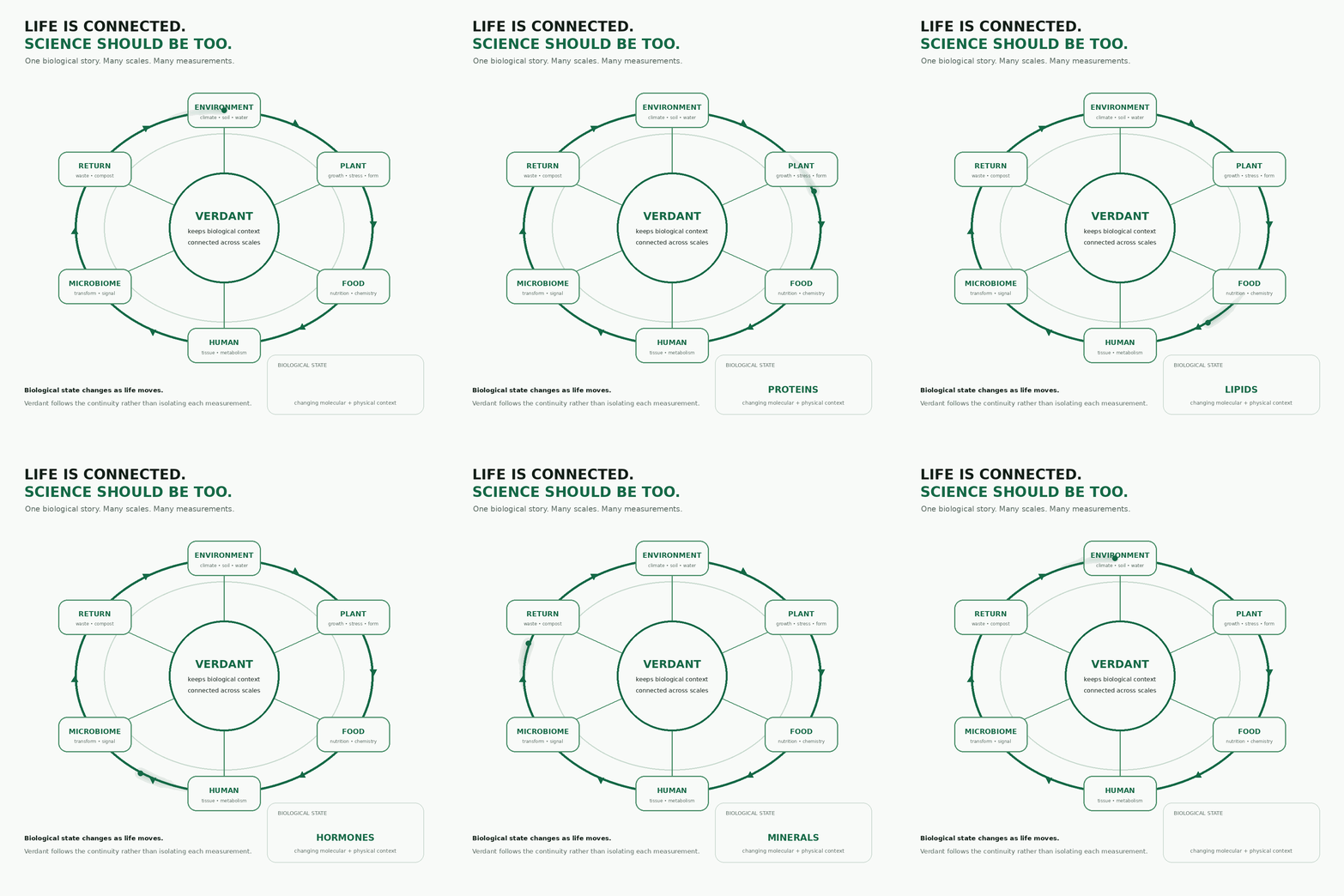
Cells, tissues, organs, organisms, microbiomes, ecosystems. Emergent behavior driven by spatial organization.

What crosses kingdoms?

Deep biological parallels: stress pathways, cannabinoid logic, sporulation vs seed biology, microbial echoes across soils, guts, and sediments.

How does environment shape biology?

Sediment structuring, root–fungi stress propagation, pollutants inside tissues, thermal–chemical–mechanical gradients.

How do we design better systems?

Spatial markers for breeding, bio-inspired sensors, spatial proteomics for materials, propagation and clean-stock design.

What else is out there?

Frontier exploration: meteorite micro-niches, altered gravity biology, prebiotic soil patterns, coral synchronization signals.

Do you have a question like the ones above?

Start a project. Join a node. Submit a proposal.

Verdant exists to help you map the biology you can’t ignore.

Science That Sees in Context

From kelp forests to soils, from plant roots to sediments, Verdant helps scientists visualize biological and ecological systems in place.

Discovery becomes shared terrain — mapped together, stewarded together, learned together.

Context illustration

Open Knowledge

Shared protocols, reproducible templates, and a collaborative ecosystem that grows with the science.

Spatial Platforms

Spatial-omics imaging, MALDI integration, and workflows spanning biological systems.

Networked Science

Distributed collaboration connecting labs, field sites, and researchers worldwide.

Internal Strategic Vision

For partners, collaborators, and leadership

Science as stewardship.
Curiosity as collaboration.
Precision as kindness.

Verdant sustains this rhythm: steady enough to trust, open enough to surprise, light enough to grow.

Once You Join

What it feels like to enter the Verdant ecosystem

Verdant is not a website. It’s a workspace you step into. Once you join, you're connected to the people, tools, and workflows that make spatial biology collaborative instead of isolated.